The AI industry has a carbon accounting problem it has not yet fully acknowledged. Every inference request, every training run, every embedding generation consumes real energy — energy that produces real emissions, measured in real tonnes of CO₂ equivalent, that sit in an organisation's Scope 2 and Scope 3 inventory whether or not the sustainability team knows they are there. As AI workloads scale from experimental to production-critical, the gap between what organisations report about their AI-related emissions and what those emissions actually are is widening into a material ESG disclosure risk. The organisations closing that gap now are doing so by treating AI compute as a first-class emissions source — not as a footnote to the data centre category.
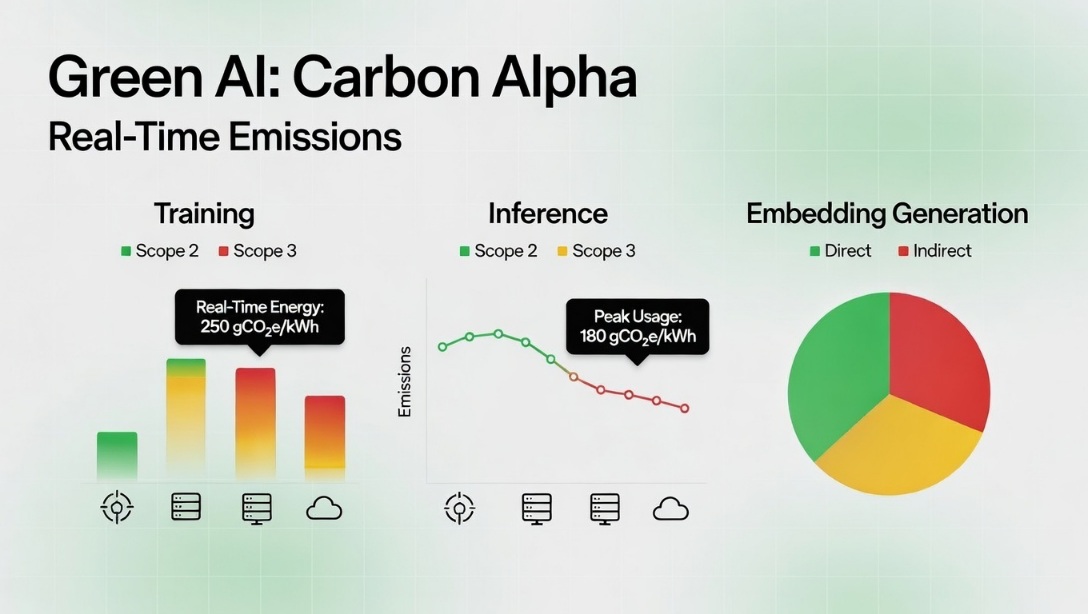
Defining Carbon Alpha
Carbon alpha is the measurable sustainability advantage an organisation generates by running AI workloads more efficiently than the industry baseline — expressed as the difference between the emissions that would have been produced running equivalent workloads at average infrastructure efficiency and the emissions actually produced. It is the sustainability equivalent of financial alpha: the excess return attributable to deliberate optimisation rather than market-rate performance.
The concept matters for ESG reporting because it shifts the framing from how much did your AI cost the climate to how much better or worse than baseline are you performing — a framing that is more actionable for sustainability teams, more credible to investors assessing AI-related climate risk, and more aligned with the trajectory of regulatory disclosure requirements that are moving toward intensity-based rather than absolute metrics.
"You cannot manage what you cannot measure. And right now, most organisations cannot tell you how many kilowatt-hours their AI consumed last quarter — let alone what carbon intensity that represented."
Real-Time Compute Metrics
Measuring AI carbon alpha requires four categories of real-time compute metrics collected at workload level, not at the data centre level. Data centre-level energy reporting tells you the total consumption of a facility; it cannot tell you which workloads consumed what, which is the granularity required for ESG disclosure purposes.
← scroll to see more →
| Metric | Unit | ESG Relevance | Collection Method |
|---|---|---|---|
| GPU/TPU Energy Draw | kWh per job | Direct Scope 2 input | NVIDIA NVML / hardware telemetry |
| Carbon Intensity of Grid | gCO₂eq / kWh | Scope 2 market-based conversion | Electricity Maps API ↗ |
| PUE (Power Usage Effectiveness) | Ratio | Infrastructure efficiency multiplier | Data centre operator reporting |
| Model Efficiency (FLOPs / output) | GFLOPs per token | Carbon alpha numerator | Framework profilers (PyTorch, JAX) |
| Water Usage Effectiveness | Litres / kWh | Scope 3 water stress reporting | Data centre operator or WRI Aqueduct ↗ |
Integrating into ESG Reporting
AI compute emissions sit across two Scope categories depending on the deployment model. For workloads running on owned or leased infrastructure, GPU and TPU energy consumption is a Scope 2 emission — indirect, from purchased electricity, calculated using the grid carbon intensity at the location and time of consumption. For workloads running on third-party cloud platforms, the classification is more complex: the energy consumption is embedded in the cloud provider's Scope 1 and 2 inventory, making it a Scope 3 Category 1 (purchased services) emission for the organisation consuming the compute.
The practical integration path for most organisations is to instrument the compute layer first — establish workload-level energy telemetry before attempting to map it to ESG frameworks. A carbon figure without a documented measurement methodology is not a disclosable figure; it is an estimate with no audit trail. The sequence is: instrument, calculate, document, disclose — in that order, without shortcuts.
Applicable Standards & Frameworks
Three external resources define the current best-practice methodology for AI compute emissions accounting and are the appropriate references for any organisation building a defensible disclosure:
- ML CO₂ Impact Calculator ↗ — The reference tool for estimating training run emissions from hardware type, runtime, and cloud region. Published methodology is citable in ESG disclosures and aligned with GHG Protocol Scope 2 guidance.
- ISO 14064-1:2018 ↗ — The international standard for GHG quantification and reporting at the organisational level. Provides the boundary definition methodology for determining whether AI workloads fall inside or outside the organisational reporting boundary.
- GHG Protocol Scope 3 Technical Guidance ↗ — The authoritative methodology for Category 1 purchased services emissions, including cloud compute. The spend-based and activity-based calculation methods are both documented here with worked examples.
- Green Software Foundation SCI Specification ↗ — An emerging standard for software carbon intensity that provides a per-functional-unit emissions metric (CO₂eq per API call, per inference, per user) — directly applicable to AI workload reporting and increasingly referenced in procurement sustainability requirements.
From Measurement to Reduction
Measurement without a reduction strategy is disclosure without accountability. Once workload-level carbon metrics are in place, three levers are available to generate genuine carbon alpha — measurable reduction below the industry baseline that can be reported, verified, and credited in ESG disclosures.
- Temporal shifting: Scheduling non-real-time training and batch inference workloads to run when the grid carbon intensity is lowest — typically overnight in renewable-heavy markets. Electricity Maps and similar APIs make this automatable; reductions of 20–40% in training-run carbon intensity are achievable without any hardware or model changes.
- Model efficiency optimisation: Quantisation, pruning, and distillation reduce the FLOPs required per inference output — directly reducing energy consumption per unit of AI output. A quantised model running at INT8 precision can deliver equivalent output quality at 30–50% of the energy cost of its FP32 equivalent.
- Infrastructure right-sizing: GPU overcapacity is the most common source of avoidable AI emissions. Workloads provisioned for peak demand but running at 20% utilisation for 80% of their runtime are emitting at peak rates for most of their operating hours. Autoscaling, spot instance strategies, and workload consolidation address this without affecting output quality.
Key Takeaways
- AI compute emissions are a material and growing component of enterprise carbon footprints — sitting in Scope 2 for owned infrastructure and Scope 3 Category 1 for cloud compute. Both require workload-level measurement, not data centre aggregates.
- Carbon alpha — performance against the industry efficiency baseline — is the right metric for AI sustainability reporting. It is actionable, auditable, and aligned with the direction of regulatory disclosure requirements.
- Four metrics are required for workload-level AI carbon accounting: GPU/TPU energy draw, grid carbon intensity, PUE, and model efficiency (FLOPs per output unit).
- Temporal shifting, model quantisation, and infrastructure right-sizing are the three primary levers for generating measurable carbon alpha — each reducible to a verifiable, disclosable figure.
- Reduction claims without a documented, consistent baseline are a greenwashing liability. The measurement methodology must be established before the reduction is claimed.